Team based in Fuzhou · UTC+8

Custom software for wholesalers and small factories: orders, stock, statements

The same item sells at a different price to each customer — pick the customer and the price fills itself in. Stock drops only when goods actually ship. Month-end statements export to Excel, ready for your customer to sign.
Built around how you already work, not the other way round.

  • You get the source code and the docs
  • Hand it to anyone else later
  • Pay in three stages
Wholesale ordering · Owner dashboard
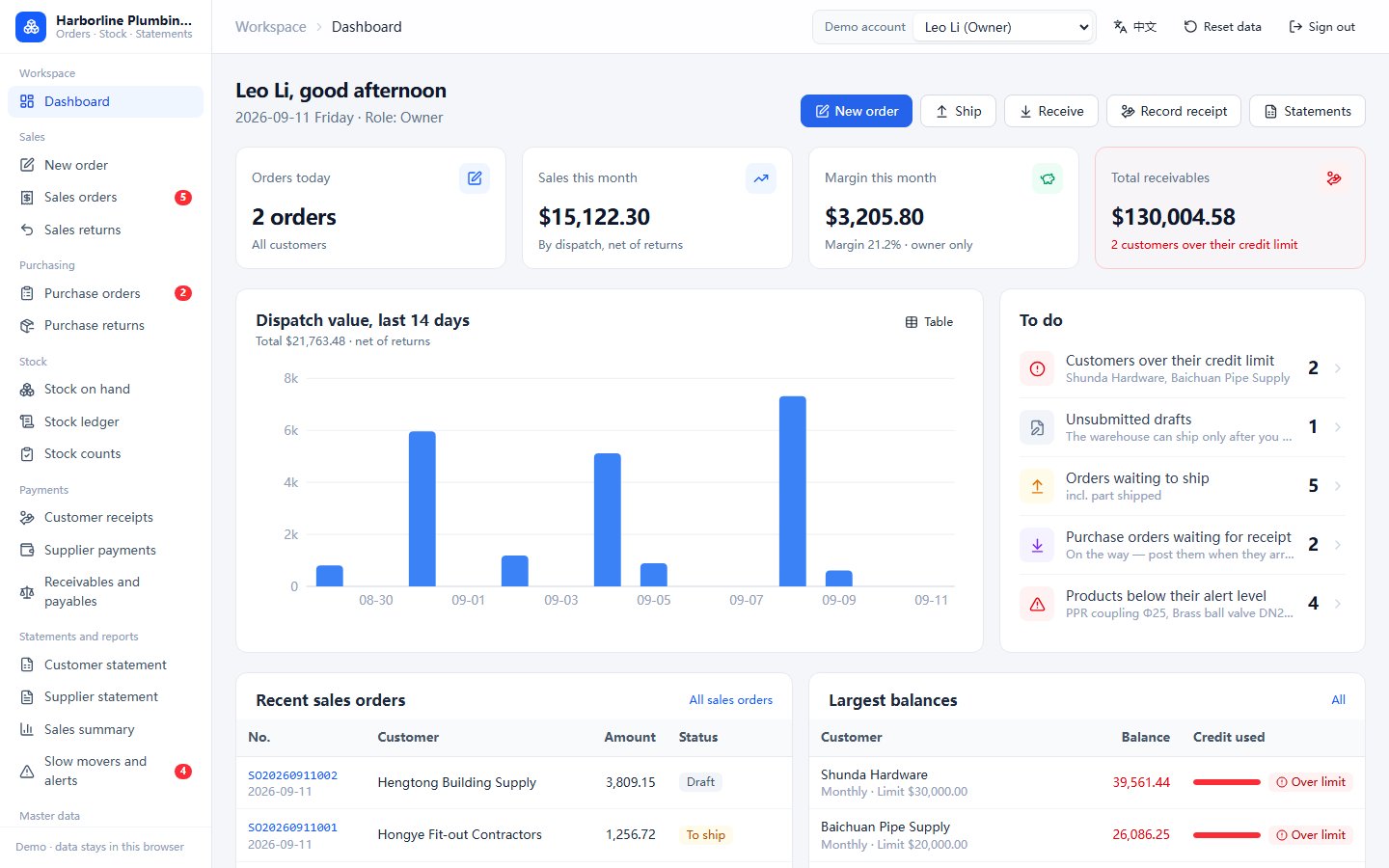
Owner dashboard: monthly sales, margin, receivables and low-stock alerts
Posts into your accounting systemRetries by itself, never duplicates
2 demosno sign-up, just open and click
Interface testedchecked against a public test environment
Source is yourssource code and deployment docs ship with it
Three payments40/30/30, a clickable version first

Solutions

Four things we mainly build for wholesalers and small factories

You see a version you can click on before the work goes further.

Order entry & inventory

  • Pick a customer and their prices fill in
  • Stock drops only when goods actually ship
  • Month-end statements, one click to Excel
  • Owner, sales, warehouse and finance each see their own part

Customer ordering portal

  • Customers place orders themselves
  • You approve, then it becomes a sales order
  • Each customer sees their own prices
  • Same products and price lists as order entry

Orders go into accounting by themselves

  • Dispatches post straight into the account set
  • Failed pushes retry — no lost orders
  • Pushing twice never creates a second document
  • Every request and response is kept

Taking over half-finished projects

  • Connect systems that don't talk to each other
  • Pick up half-finished or stalled builds
  • We read the code first, then decide: continue or rebuild
  • No charge if the assessment says we can't take it on

Features

Pricing, dispatch, month-end — those three things

These are real screens from the demo. The rules follow how wholesale actually works; the data is fictional.

01

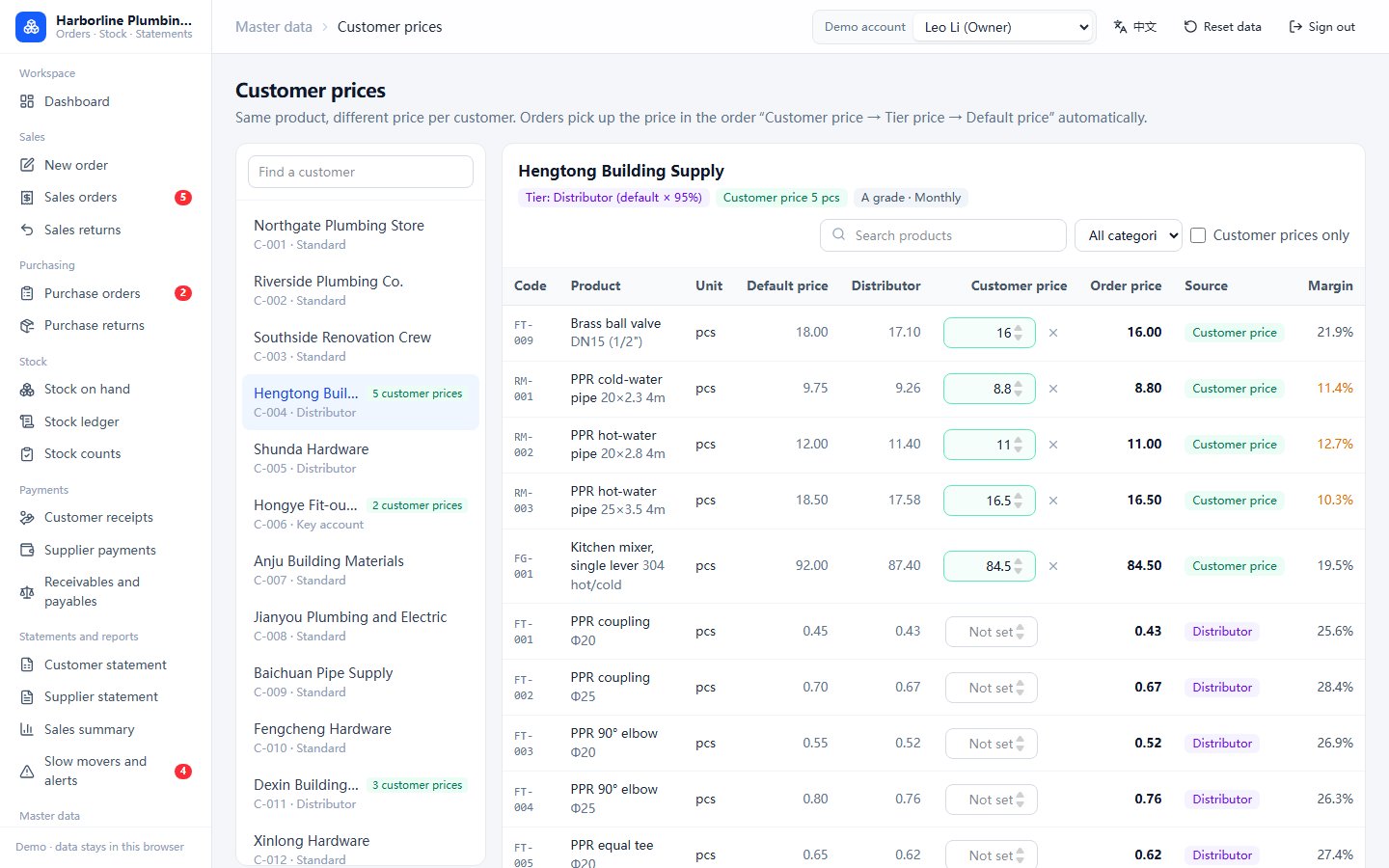
Same item, a different price per customer

The same product at a different price for each customer. On every order, the price fills in as customer price → tier price → default price, and every change is logged.

  • Price source is colour-coded on the order
  • Below the minimum price needs the owner's account
  • Each price change records who, before and after
Customer price lists: customer prices and tier prices for the same product
02

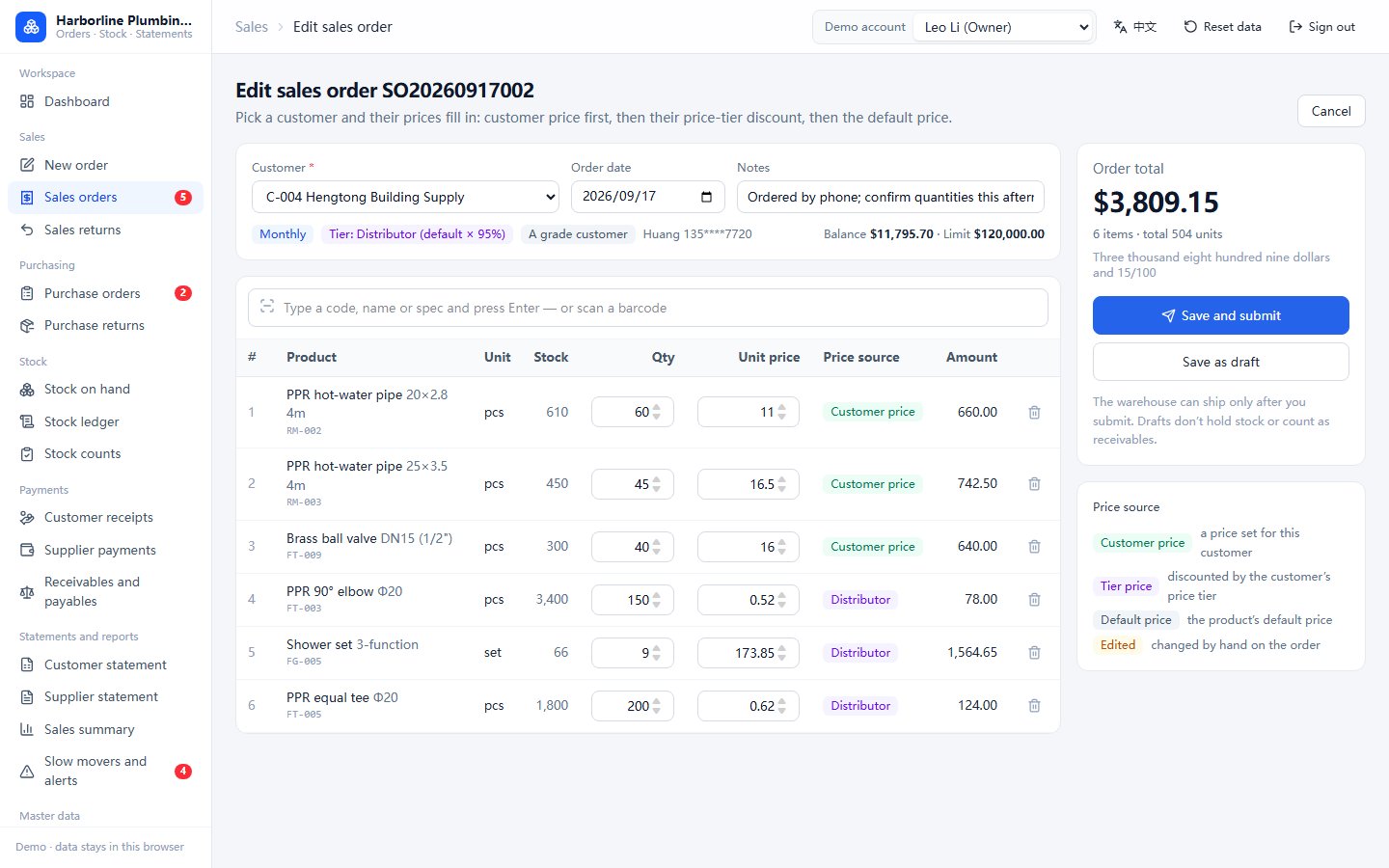
Stock drops only when goods ship

Taking an order doesn't touch stock. Stock goes down and the receivable is booked only when the warehouse posts what actually went on the truck.

  • Drafts hold no stock and count as no receivable
  • Shipped orders can only be returned or closed, never edited
  • Over-credit orders prompt and leave a log entry
Sales order: customer prices fill in with their source shown
03

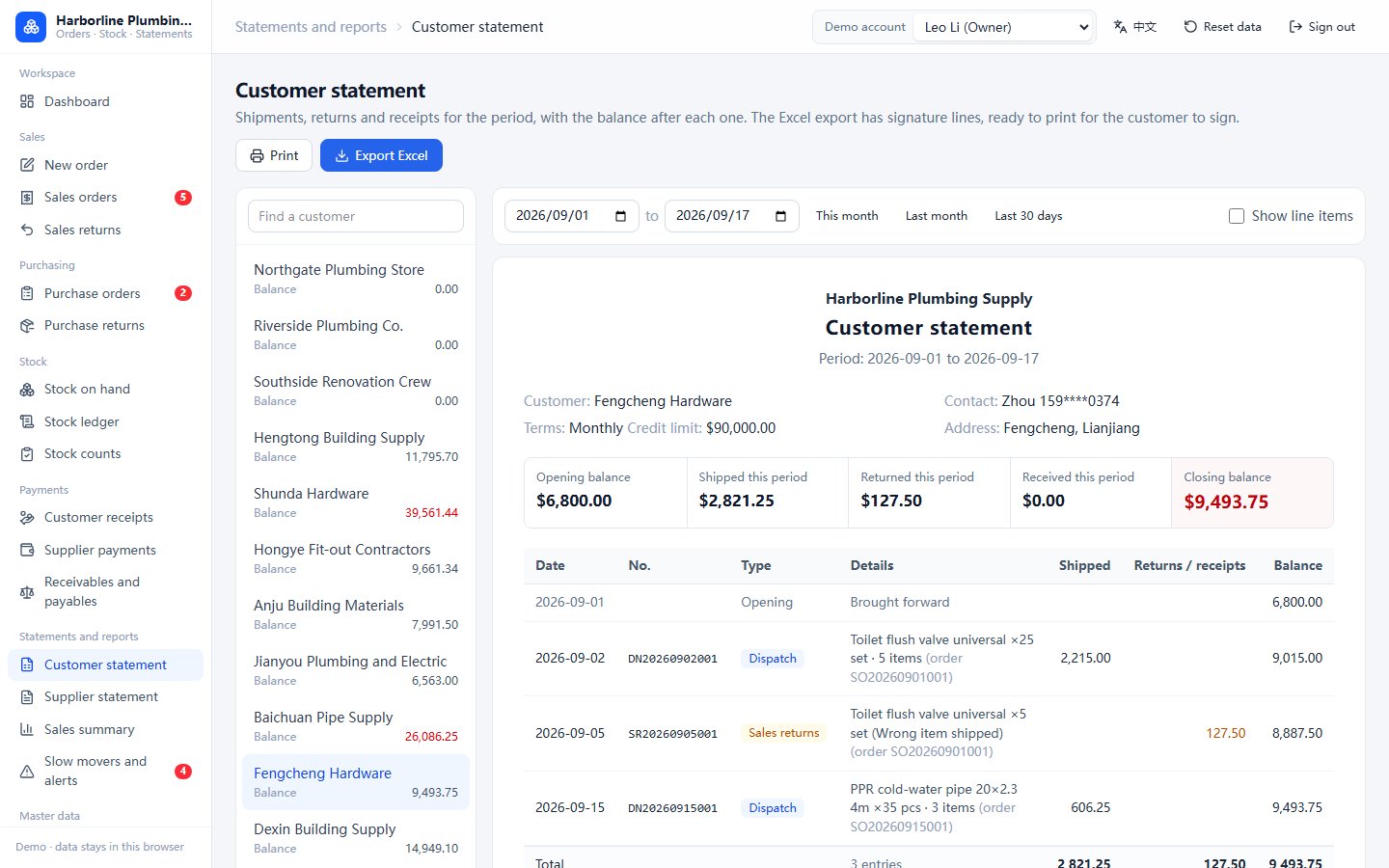
Month-end statement, one click to Excel

Opening balance, every dispatch, return and receipt, the balance after each one, and the closing balance. The Excel export has signature lines, ready to print for the customer.

  • Opening + dispatched − returned − received = closing, to the cent
  • Expand to line items when needed
  • Supplier statements export the same way
Customer statement: opening balance, activity, closing balance

A good fit

If any one of these sounds like you

  • Same SKU, different price per customer — still quoting in spreadsheets
  • Stock should move only after goods go out, and you need a statement at month-end
  • Customers still order in chat, and you want them to place orders themselves
  • Agency or implementer with overflow — white-label delivery, never in contact with your client

Work

Two demos you can click through, one real project

Owner dashboard of the wholesale order and statement system
Demo · Try it live

Wholesale Order & Statement System

Each customer's own prices fill in automatically, stock only moves when a receipt or dispatch is posted, and statements export straight to Excel. Owner, sales, warehouse and finance each see only what their role allows.

Demo system: the rules follow how wholesale actually works; the data is fictional and it isn't any client's project.
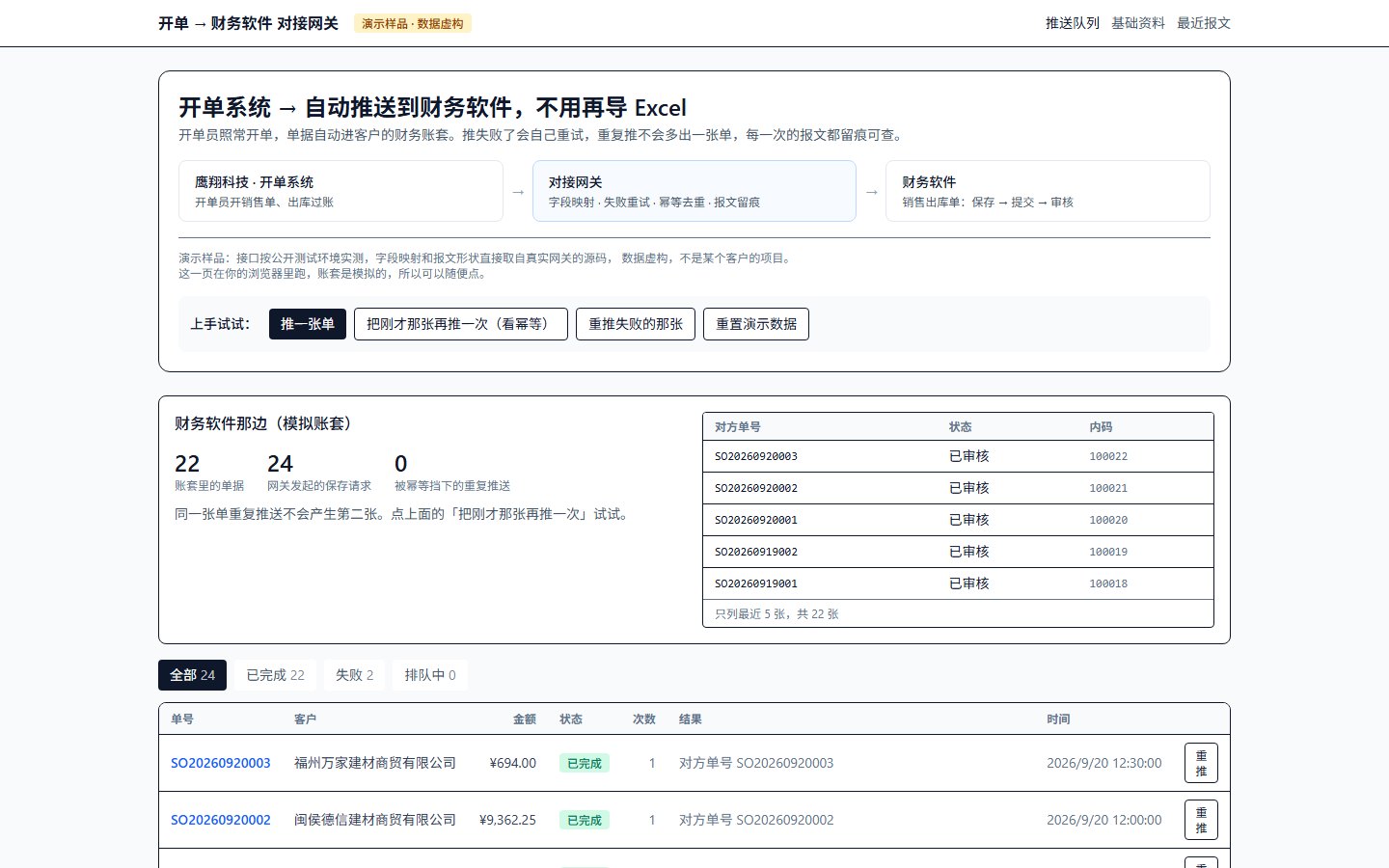
Integration gateway posting orders into the accounting system
Sample build · Try it online

Orders posted straight into accounting

Each dispatch posts into the account set, failed pushes retry themselves, pushing the same order twice never creates a second document, and every request and response is kept.

Sample build: API shapes tested against a public test environment; the data is fictional. Interface in Chinese.

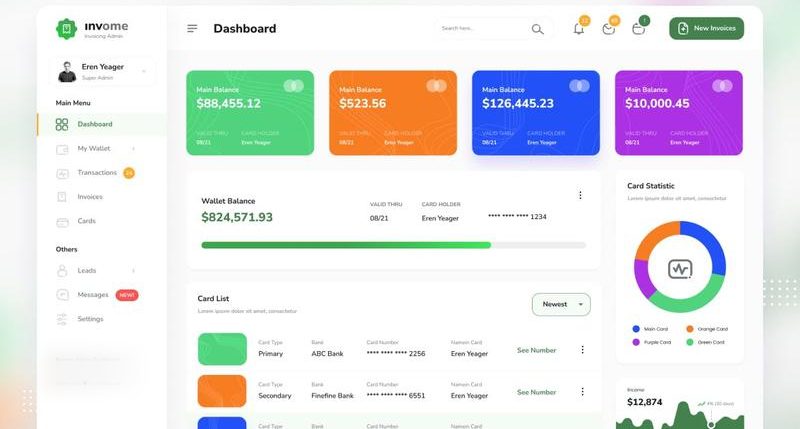
Invoicing console showing balance overview and card statistics
Client project · Screenshots redacted

Invoicing & Finance Console

A back-office for finance and management. Multi-account balances, transaction history and card statistics on one board, with role-based control over who sees which figures.

Delivered: front end, back end, dashboards, permissions, through to deployment.

Pricing

We quote once the rules are clear, first version live in 2–6 weeks

Bigger rule sets split into two phases, each quoted and signed off on its own.

The three usual shapes

Wholesale / factory order entryPrice lists, posted dispatch, statements
Customer ordering portalThey order, you approve
Both, with simple rulesOrder entry + portal in one go
40%to start 30%on a clickable demo build 30%on launch sign-off

Pricing depends on how complex your rules are. Tell us how you invoice today and you normally get a range the same day. You see a clickable version first, then it goes live. No general ledger, no production scheduling; statement data exports to the accounting software you already use.

Which one are you

Owner · for your own business

Keep your accounting software. Yingxiang builds only the ordering, price-list and statement part. The source belongs to the client.

Agency / implementer · white-label

The client stays yours. Ordering and inventory are delivered white-label. Terms go in the contract.

Company websites, branded shops and unfinished builds are taken on too — send over how you use things today.

Process

Five steps, and you can stop at any of them

  1. 01

    Scoping call

    Tell us what you're solving. We judge whether it can be built and whether it's worth it. No charge either way.

  2. 02

    Scope & plan

    Clear deliverables, scope and timeline before anything starts. Not a fit? We stop there.

  3. 03

    Staged build & payment

    40 / 30 / 30. Bigger rule sets split into two phases, each quoted and signed off on its own.

  4. 04

    Handover

    Full source and deployment docs handed over. No lock-in — the client can bring in anyone to maintain it.

  5. 05

    After delivery

    15 days of free bug fixes. Ongoing maintenance available as a separate arrangement.

Why Yingxiang

How this differs from a typical agency

Typical agencyYingxiang
Timeline1–2 months2–6 weeks to a first live version
Who you talk tosales → PM → devstraight to the delivery lead
Small scopesdeclinedassessed, then taken on
Source codeextra, or neverhanded over with the project
Subcontractingopaquewhite-label build, no contact with your client
If it stallscostly to replacesource and docs transferable

Requirements go straight to the delivery lead, not relayed through sales or project managers. Source ships with the project, and common modules are reused, so similar builds take less time. Team based in Fuzhou, China (UTC+8), with solid overlap with European mornings and US evenings.

For partners

How agencies, studios and fellow developers work with us

Ongoing white-label delivery, build only. The client relationship stays with the partner — no contact during the project or after it. Source ships with the work, so the partner can maintain it or hand it on. Partners we've worked with can vouch for us.

Doing ERP rollouts? Posting orders straight into the account set is already working. Your licence business is untouched; Yingxiang delivers the customisation your clients ask for. See the demo

  • Marketing and web agenciesthe builds your clients ask for
  • Design studiosthe development half of a full-package project
  • Software resellersthe customisation clients keep requesting
  • System integratorssubcontracting that holds its schedule

Business enquiries · Book a demo

The fastest way to start: describe the problem in one line. Something like “we spend 3 days a month reconciling invoices” is enough.

We usually reply within 24 hours. If it's a fit you'll get an approach; if not, we'll explain why or suggest another direction. Contracts welcome; invoicing arrangements can be discussed up front.